If you’ve ever held a flashlight up to an egg in a dark room, you already know the basic idea behind candling. It’s one of the coolest parts of hatching eggs. You get to actually see what’s happening inside the shell — and watching a tiny chick grow over 21 days never gets boring, no matter how many times you’ve done it.
This guide walks you through every stage, day by day, in plain simple language. No confusing terms, no overwhelming details. Just what you need to know.
What Is Candling?
Candling means shining a bright light through an egg so you can see inside it. You do it in a dark room, hold the egg up to a small flashlight or an egg candler, and look through the shell.
The name comes from the old days when people used a real candle to do this. These days a cheap egg candler (around $5–$10) or even a phone flashlight in a dark room works fine.
You mainly candle eggs for three reasons. First, to check if the egg is actually fertile and developing. Second, to remove eggs that have died so they don’t go bad and affect the others. Third, to make sure the air cell inside is growing at the right pace, which tells you if your humidity is correct.
A Few Things to Know Before You Start
You don’t need to candle every single day. Most people candle around Day 7, Day 14, and Day 18. That’s enough to catch problems without disturbing the eggs too much.
Always work in a dark room — the darker the better. Keep your candling sessions short, under 10 minutes, so the eggs don’t cool down too much.
Handle the eggs gently. Hold them at the blunt end (the rounder end) up to the light. Rotate slowly to see different angles.
If you’re not sure whether an egg is developing or not, don’t remove it right away. Mark it with a pencil and check again in two days. It’s better to wait and be sure than to throw away a perfectly good egg.
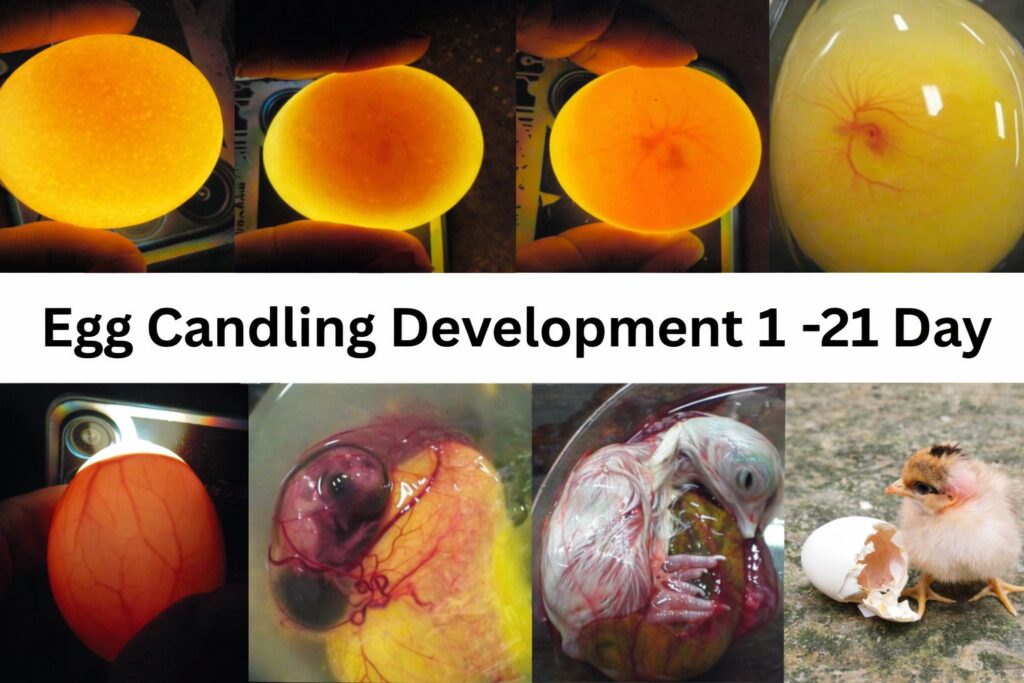
Day by Day — What to Expect
Day 1
You just put the eggs in the incubator. Nothing to see yet. The egg looks opaque and yolky when you shine a light through it. That’s completely normal. Fertilization has already happened before the egg was laid, but development has just started.
Make sure your incubator is sitting at 99.5°F (37.5°C) if it has a fan, or about 101°F if it doesn’t. Humidity should be around 45–55%. Mark each egg with an X on one side and an O on the other with a pencil so you can track turning.
Day 2
The embryo has started forming. In fact, the heart begins beating around 36 to 44 hours after you set the eggs — so somewhere on Day 2, a tiny heart is beating inside your eggs.
You can’t see this when candling yet. The egg still looks the same. But something is happening, and that’s exciting.
Day 3
By the end of Day 3, tiny blood vessels are starting to spread out from the embryo like a spider web. If you candle carefully, you might see a faint reddish or pinkish spot near the center and some thin veins spreading out from it.
This is the first real sign of life. Most people can’t see much at Day 3, so don’t worry if you can’t. Wait a few more days for a clearer picture.
Day 4
The blood vessels are more developed now. You should be able to see the spider web of veins more clearly. You’ll also notice the air cell starting to form at the blunt end of the egg — it looks like a small clear space, like a little bubble.
Some people can spot a tiny dark dot floating in the middle — that’s the actual embryo. It might look like a tiny speck with veins spreading away from it.
Day 5 to Day 7 — Your First Proper Candle
This is the best time to do your first real candling session. By Day 7, you can clearly tell the difference between a developing egg and one that isn’t going to hatch.
A good, developing egg at this stage shows a clear web of red veins spreading through the egg, a visible dark spot (the embryo), and a small but defined air cell at the blunt end. Sometimes you’ll even see the embryo move — a tiny twitch or wiggle. That’s one of those moments you won’t forget.
An infertile egg looks completely clear. The yolk might float around as a shadow, but there are no veins, no dark spot, nothing. These are called “clear eggs” and you can remove them.
A third thing to look for is a blood ring — this is a ring of blood sitting inside the egg with no embryo attached to it. It means the embryo started forming but died early on. Remove these too. If they stay in the incubator too long, they can go bad, crack, and contaminate your other eggs.
Day 8 to Day 10
The embryo is growing fast during these days. The egg looks noticeably darker when you candle it because there’s more chick taking up space inside. The veins are spreading further, and the whole upper part of the egg has a warm reddish glow to it.
By Day 10, the chick has all its major organs, a recognizable bird shape, and even tiny feather follicles forming under the skin. You probably won’t see that level of detail when candling, but it’s happening.
What you will see is the dark mass of the embryo growing bigger each time you candle, and the air cell slowly getting larger at the blunt end.
Day 11
Halfway point! The chick looks like a real bird now, just very small. It has a beak, claws, and wings beginning to take shape.
When you candle at Day 11, the egg looks noticeably darker than it did a week ago. The veins form almost a red halo around the dark embryo. The air cell is now roughly a quarter to a third of the egg’s total space.
This is a good time to check your humidity. The air cell grows because moisture slowly evaporates out of the egg over the 21 days. If the air cell looks too small, your humidity might be a little high. If it looks too large, humidity might be a little low. Adjust accordingly.
Day 12 to Day 14
The chick is filling up more and more of the egg. By Day 14, you’re not seeing as much fine detail when you candle — mostly just a large dark shape taking up most of the egg, with the air cell clearly visible at the top.
A living egg at Day 14 will sometimes move. You might see a slight shift or wobble as the chick changes position. That’s a great sign.
If an egg looks totally dark and uniform with no movement and no visible structure, it might have died. Mark it and check again the next day before you remove it. Dead eggs can also start to smell — a faint bad smell is a warning sign.
Day 15 to Day 17
At this stage there’s not much to see in detail when you candle. The chick fills most of the egg now. You’ll see a large dark mass and the air cell, and not much else.
What you’re mainly checking at this point is that the air cell is continuing to grow and that the egg doesn’t smell bad. If you press your ear gently to the egg in a quiet room, you might even hear faint sounds — the chick moving around inside.
Day 18 — Lockdown
Day 18 is an important day. This is when you stop turning the eggs, raise the humidity to around 65–70%, and stop opening the incubator. This is called “lockdown.”
The reason you stop turning is that the chick needs to position itself for hatching. It needs to get its head facing the air cell at the blunt end and its beak tucked under its right wing. If you keep turning the eggs after Day 18, the chick can end up in the wrong position, which makes hatching much harder.
If you candle on Day 18, you’ll see the dark mass nearly filling the entire egg. The air cell is now large — maybe taking up a third to almost half of the egg. You might notice the border between the air cell and the dark mass looks wavy or uneven. That’s actually the chick’s head beginning to push up into the air cell space. It’s a good sign.
After Day 18, leave the incubator closed and don’t touch anything. Just wait.
Day 19 — Internal Pip
Around Day 19, something called internal pip happens. The chick breaks through the inner membrane that separates it from the air cell and takes its very first breath of air.
You might hear faint peeping sounds if you hold the egg close to your ear in a quiet room. This is the chick calling out from inside — it’s alive and getting ready.
You may or may not notice any visible change when candling. Sometimes you can see a small indentation in the wavy border of the air cell where the chick’s beak is pushing. But don’t candle unless you’re checking for problems — you’re in lockdown now.
Day 20 — External Pip
This is when hatching officially begins. External pip is when the chick cracks a small hole through the shell itself using its egg tooth — a tiny hard tip on its beak designed for exactly this moment.
You’ll see a small crack or hole appear on the egg, usually near the large end. It might look like a small star-shaped chip in the shell. Once this happens, hatch is typically somewhere between 12 and 24 hours away, though it can sometimes take a bit longer.
The most important thing right now: do not help. It’s very tempting to assist when you see a chick struggling, but the chick needs this time to rest, absorb its yolk sac, and detach the blood vessels in the membrane. If you help too early, the chick can bleed and die. Unless it’s been over 24 hours with zero progress after external pip, leave it alone.
Listen to your incubator — you’ll probably hear cheeping quite clearly now.
Day 21 — Hatch Day
Day 21 is the average hatch day for chicken eggs, but some chicks hatch on Day 20 and some take until Day 22 or 23. Don’t panic if your hatch day doesn’t perfectly match the calendar.
After external pip, the chick works its way around the shell in a process called zipping. It rotates slowly, pushing against the shell until the cap pops off and it tumbles out. It looks exhausted and wet at first — not the fluffy cute chick you’re imagining. Give it a few hours to dry off in the incubator.
Keep the incubator closed until your chicks are dry and fluffy. Opening it too early drops the humidity and can cause other eggs that are still hatching to dry out and get stuck.
After 24 hours, move your dry, fluffy chicks to a brooder with warmth, water, and chick starter feed. They’ll do just fine.
Quick Reference
| Days | What You See | What to Do |
|---|---|---|
| 1–4 | Nothing or faint veins | Set temp and humidity. Mark eggs. |
| 5–7 | Veins, embryo dot, blood rings | First candle. Remove bad eggs. |
| 8–14 | Growing dark mass, air cell | Second candle around Day 14. |
| 15–17 | Large dark mass | Check for smells. Monitor air cell. |
| 18 | Large mass, wavy air cell | Stop turning. Raise humidity. Lockdown. |
| 19–20 | Internal then external pip | Listen and watch. Don’t help. |
| 21 | Hatch! | Leave closed until chicks are dry. |
Final Thoughts
Candling doesn’t need to be complicated. A few check-ins at the right times, a good eye for the signs of life (or lack of it), and a bit of patience is all you really need.
The first time you see a tiny embryo moving inside an egg, or hear a chick cheeping before it’s even out of the shell, it’s genuinely one of the coolest things. Enjoy the process. Good luck with your hatch.