So you’ve got pigeons around your home, maybe on your balcony or in your backyard, and you’re curious — is that one a boy or a girl? Honestly, you’re not alone. This is one of those questions that sounds simple but sends even experienced bird lovers scratching their heads.
Unlike chickens or ducks, pigeons don’t have a giant flashing sign telling you which is which. But once you know what to look for, it starts to click. Let me walk you through everything I’ve picked up over the years.
First, a Reality Check
Here’s the honest truth — pigeons are not easy to sex at a glance. Both males and females look almost identical in terms of feather color and pattern. There’s no dramatic difference like a peacock’s tail or a rooster’s comb. You have to observe their size, behavior, and a few subtle physical cues together.
One sign alone can mislead you. Look at the whole picture.
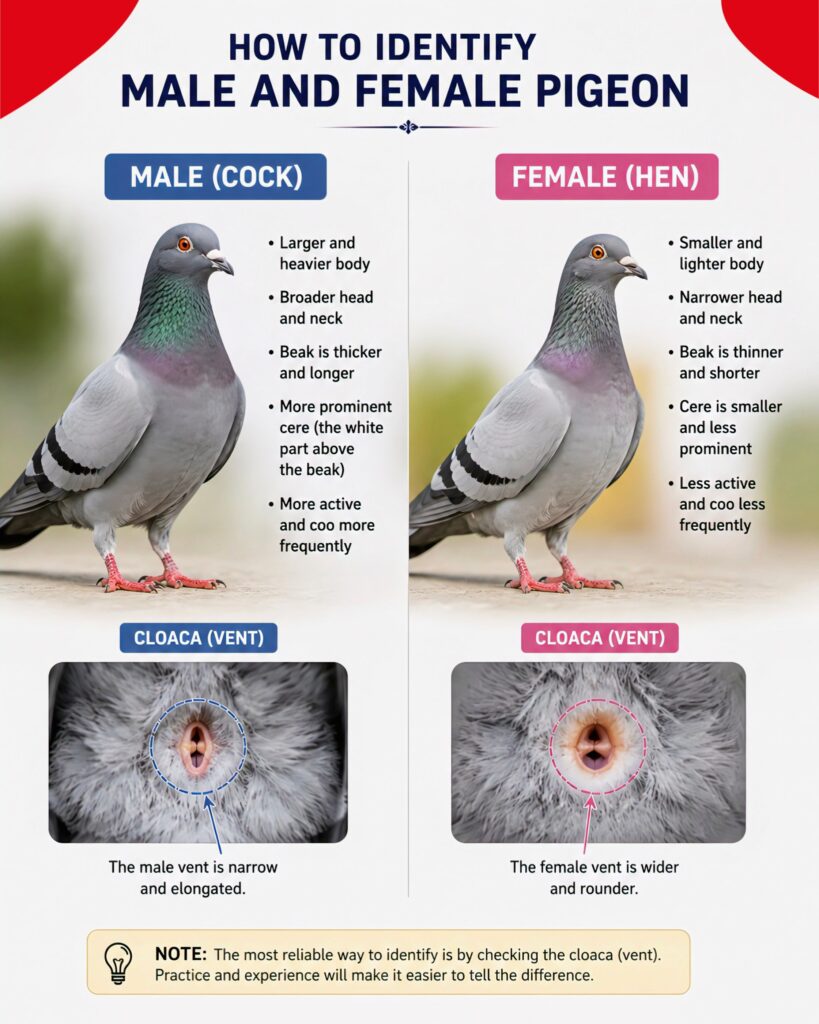
1. Body Size and Build
This is usually the first thing people notice.
Male pigeons (cocks) tend to be slightly larger and stockier. Their chest is broader, their neck is thicker, and overall they just carry a bit more bulk. If you put a male and female side by side, the male often looks like he’s been hitting the gym — not dramatically bigger, but noticeably more solid.
Female pigeons (hens) are generally a little smaller and more slender. Their build is lighter, and their neck appears thinner in comparison.
Now, this isn’t a hard rule. Young males or small breeds can throw you off. But as a starting point, look at the frame.
2. Head Shape
Look closely at the head — this one is surprisingly useful.
Males tend to have a rounder, more domed head. It looks fuller and more prominent, almost like a well-rounded ball sitting on their neck.
Females usually have a flatter, more oval-shaped head. The profile from the side looks a little more elongated and refined.
It’s subtle, but once you start comparing, you’ll see it.
3. Watch the Behavior — This Is the Big One
If you want the most reliable clue, just watch them for a few minutes. Behavior tells you almost everything.
The male pigeon is a showoff. Full stop. He will:
- Puff up his chest and strut around like he owns the place
- Coo loudly and repeatedly — that deep, rhythmic coo-coo-coo you hear is almost always a male calling out
- Chase the female in circles, following her relentlessly
- Bow his head repeatedly while spinning around her — this is called a courtship bow, and it’s very distinctive
- Fan out his tail feathers while doing all of the above
The female, on the other hand, tends to either ignore him, walk away, or occasionally accept his advances by crouching slightly. She’s calmer, more reserved, and doesn’t initiate the strutting display.
If you see two pigeons and one is clearly doing all the chasing and puffing while the other looks mildly annoyed — the one doing the performance is your male.
4. The Cere (That Fleshy Bit Above the Beak)
This is a handy physical detail people often overlook.
The cere is the soft, fleshy area that sits just above the beak, around the nostrils. In pigeons:
- Males typically have a larger, more prominent cere — it looks puffier and more swollen
- Females have a smaller, flatter cere — less noticeable, more compact
In some breeds, the male’s cere can appear almost whitish or chalky, while the female’s looks smoother and more skin-toned. This can be easier to see in older birds.
5. Neck Feathers and Iridescence
During the right light, pigeon neck feathers shimmer with beautiful greens and purples. Both sexes have this, but males tend to display it more intensely and more often.
When a male is in courtship mode or feeling dominant, he’ll puff up and turn his neck so the iridescent feathers catch the light. It’s genuinely beautiful to watch. The female’s feathers shimmer too, but she doesn’t show them off in the same deliberate way.
6. Nesting Behavior
If you’re observing a pair that’s nesting, here’s a useful tidbit: both parents take turns sitting on the eggs, but their shifts differ.
- Males typically sit on the nest during the day (roughly mid-morning to late afternoon)
- Females take the evening and overnight shift
This isn’t a fool-proof method if you can’t watch around the clock, but it’s a good detail to know.
7. Age Matters
Young pigeons (called squabs or juveniles) are notoriously hard to sex. The behavioral differences don’t really show up until they start maturing, usually around 5–6 months. Before that, even experienced pigeon keepers sometimes can’t tell without a DNA test or a vet’s help.
So if you’re looking at a young bird and can’t figure it out — don’t stress. Wait a little. Nature will eventually make it obvious.
Quick Reference Cheat Sheet
| Feature | Male (Cock) | Female (Hen) |
|---|---|---|
| Body size | Larger, stockier | Smaller, slender |
| Head shape | Rounder, domed | Flatter, oval |
| Cere | Larger, puffier | Smaller, flatter |
| Cooing | Loud and frequent | Quieter, less often |
| Behavior | Struts, bows, chases | Calmer, less showy |
| Nesting shift | Daytime | Evening/night |
Final Thoughts
Identifying a pigeon’s sex is part science, part observation, and honestly — a bit of an art. Don’t feel bad if you get it wrong the first few times. Even people who’ve kept pigeons for years sometimes second-guess themselves.
The best approach is to spend some time just watching them. Let the birds show you who they are. The male usually can’t help himself — he’ll start strutting and cooing before long, and all doubt will disappear.
And if you’re ever really unsure? A vet can confirm the sex with a simple DNA test. No shame in that at all.
Happy pigeon watching!