The short answer? Yes — 100 layers can absolutely make you profit as a beginner. But the longer, more honest answer is that it depends almost entirely on how you manage your farm — not how many birds you own.
If you have been researching layer farming and wondering whether starting with 100 chickens is worth the investment, you are asking the right question. Most people who fail in poultry don’t fail because the business model is broken. They fail because they start without understanding the full picture — the real costs, the management demands, and the difference between cash flow and actual profit.
This guide will walk you through everything: what it genuinely costs to start, how to manage your birds properly from day one, what to expect when production begins, and the honest range of outcomes you could see depending on how well things go. No hype. No shortcuts. Just the practical information you need to make a smart decision before spending a single dollar.
Is Starting with 100 Layers Worth It?

Layer farming is one of the most accessible agricultural businesses for beginners. You don’t need vast amounts of land. You don’t need heavy machinery. And with 100 birds, you are working at a scale that is manageable for one person to handle.
But there is a critical mindset shift that separates the beginners who succeed from the ones who lose money: layer farming is not a passive income business — it is a daily management business. Your birds need consistent feed, clean water, proper lighting, vaccination on schedule, and a healthy environment every single day for weeks before you see a single egg.
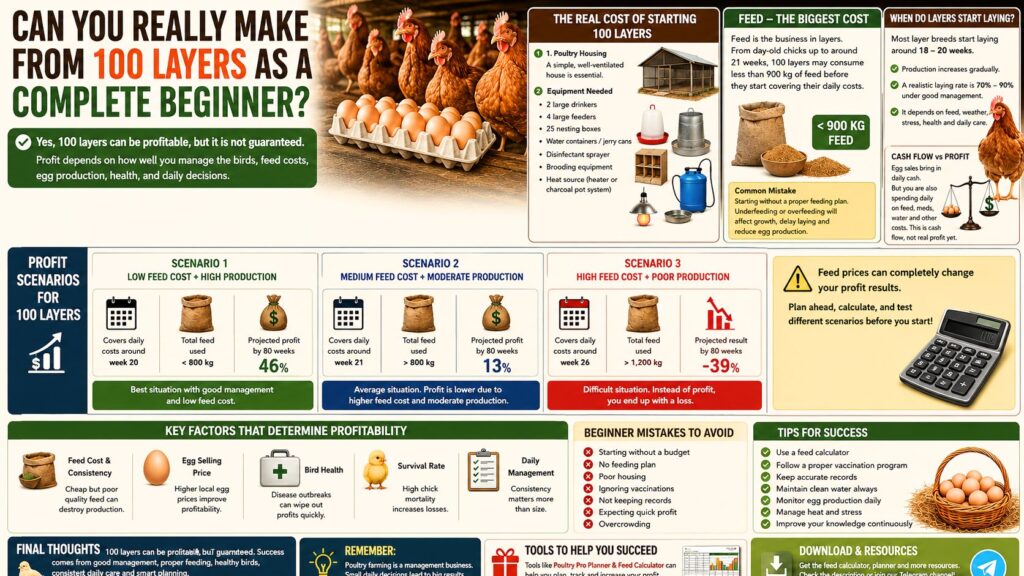
The honest truth is that 100 layers can produce a 46% return on investment over an 80-week cycle under good conditions — or a 39% loss under poor ones. The difference is not luck. It is preparation, consistency, and knowing what you are doing before you start.
- 100 layers is an ideal starting scale — manageable without staff, teachable through doing
- Startup costs are meaningful but not enormous — most beginners can fund this independently
- Eggs provide daily income once production starts — cash flow begins faster than most livestock farming
- Feed is the dominant variable — controlling it is the single biggest lever on your profit
- Results range from excellent to negative depending entirely on management quality
Realistic Startup Costs for 100 Layers
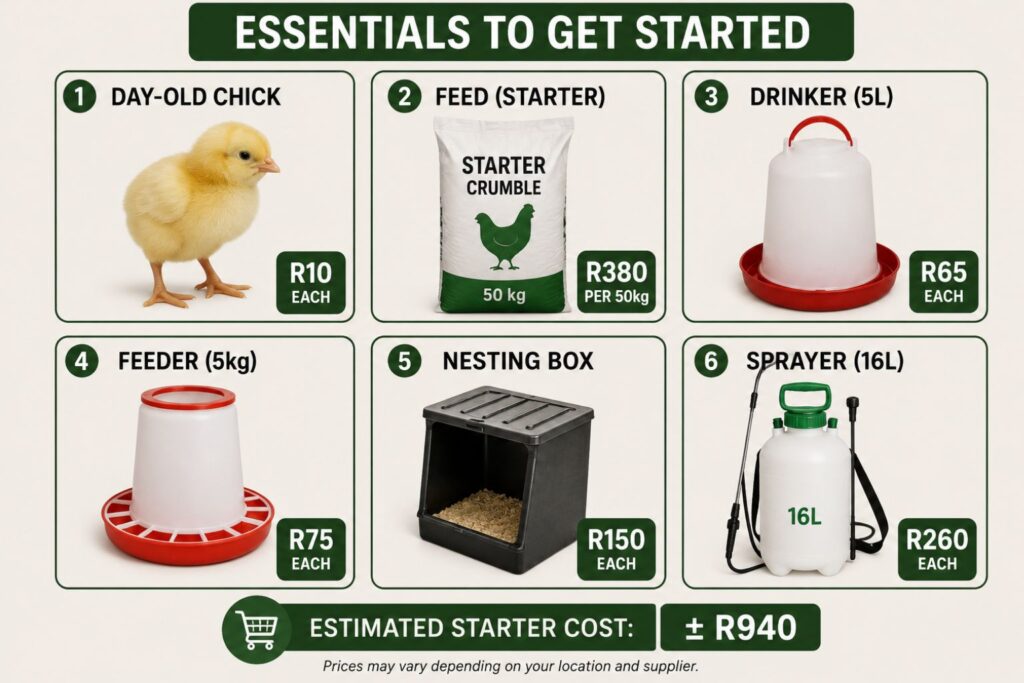
One of the most common mistakes beginners make is only budgeting for the birds. The birds are just one component. Here is what a realistic startup actually requires for 100 layers — and roughly what each element costs. Note that prices vary significantly by country and region, so treat these as a structural guide and substitute your local figures.
| Item | Details | Estimated Cost Range |
|---|---|---|
| Day-old chicks (100) | Quality breed suited to your climate | $80 – $180 |
| Housing construction | Simple ventilated structure, 10–15 sq m minimum | $250 – $600 |
| Feeders (×4 large) | Tube or trough feeders for 100 birds | $40 – $90 |
| Drinkers (×2 large) | Automatic or manual nipple drinkers | $30 – $70 |
| Nesting boxes (×25) | 1 box per 4 layers is standard | $60 – $120 |
| Brooding equipment | Heater or charcoal brooder, thermometer | $30 – $80 |
| Tools & accessories | Sprayer, water cans, egg crates, records book | $30 – $60 |
| Feed (to week 21) | ~800–1,200 kg depending on scenario | $260 – $700 |
| Vaccines & medications | Newcastle, Gumboro, Marek’s, dewormers | $30 – $60 |
| Contingency (10%) | Unexpected costs, mortality, repairs | $80 – $200 |
| Total Estimated Startup (before first egg income) | $890 – $2,160 | |
💡
Tip: The wide cost range above reflects real variation across different countries and regions. Always calculate your startup costs using your exact local prices for feed, housing materials, and chicks. A planning tool like the Poultry Pro Planner (link below) lets you enter your own numbers and see a realistic projection.
Layer Management Step by Step: From Day-Old Chick to First Egg
Understanding what your birds need at each stage of development is the foundation of profitable layer farming. Here is a simplified but practical breakdown of what good management looks like from day one through to production.
Stage 1: Brooding (Week 0–4)
Newly hatched chicks cannot regulate their body temperature. During the first four weeks, you must maintain a controlled brooding environment, starting at around 32–35°C directly under the heat source and reducing by roughly 3°C per week. Keep litter dry, ensure clean water is always available, and monitor chicks closely for signs of crowding (which indicates cold) or spreading to the edges (which indicates heat).
Stage 2: Growing Phase (Week 5–15)
Birds are transitioning from starter feed to grower feed. Housing moves from brooder to the main house. Focus during this stage is on consistent feeding, clean water, proper ventilation, and maintaining the vaccination schedule. This is where many beginners get sloppy — and it shows up later as poor laying performance.
Stage 3: Pre-Lay Development (Week 16–18)
Birds are physically developing their reproductive system. Switch from grower feed to pre-lay or layer developer feed, which is higher in calcium. This transition is critical. Birds that don’t receive adequate calcium during this window often produce weak-shelled eggs and lay inconsistently. Increase lighting at this stage to 14–16 hours per day to stimulate production.
Stage 4: Production Phase (Week 18 onward)
Birds should begin laying between weeks 18 and 20 depending on breed and management quality. Production builds gradually — don’t expect full output immediately. Transition fully to layer feed. Collect eggs twice daily, keep nesting boxes clean, and monitor production records closely. Any drop in production is a signal to investigate feed, health, water, or stress.
- Maintain a daily farm record from day one — feed consumed, mortality, health observations, production numbers
- Stick to your vaccination schedule without exception — missed vaccines lead to preventable disease
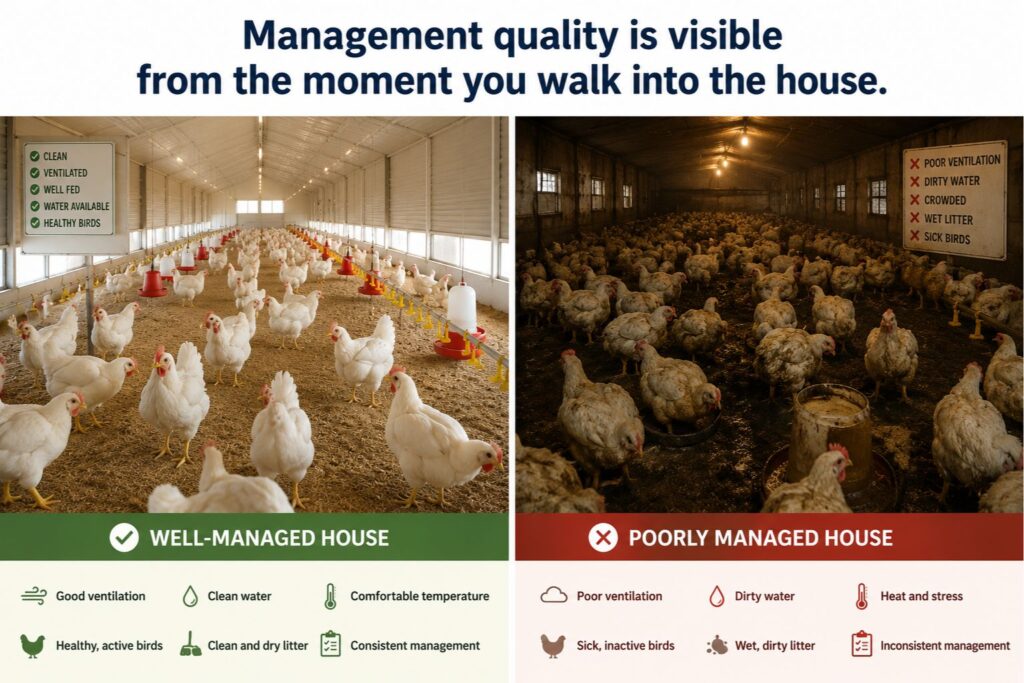
- Biosecurity matters even at 100 birds — limit visitors, disinfect footwear, isolate sick birds immediately
- Water quality is as important as feed quality — dirty water suppresses production silently.
Feed Costs and Why They Make or Break Your Farm
In layer farming, feed is not one cost among many. It is the cost. Across a full production cycle, feed typically accounts for 60 to 70 percent of your total operating expenses. Getting your feeding strategy right — and keeping it consistent — is the single most powerful thing you can do to protect your profit margin.
How Much Feed Does 100 Layers Need?
The total feed requirement from day one to the point where your birds’ egg income begins covering their daily feed cost is roughly 800 to 1,200 kg, depending on your scenario (more on that below). After that break-even point, feed consumption continues at approximately 100–120g per bird per day through the production phase.
Feed Types by Stage
- Chick Starter (Week 0–4):High protein (18–22%). Supports rapid early growth.
- Grower Feed (Week 5–15):Moderate protein (15–16%). Supports skeletal and muscle development.
- Pre-Layer Feed (Week 16–18):Elevated calcium (1–2%). Prepares the reproductive system.
- Layer Feed (Week 18+):Balanced protein (16–17%) and high calcium (3.5–4%). Supports daily egg production.
The Feed Planning Mistake That Costs Beginners the Most
Knowing your total feed budget is not enough. You need to know the exact daily requirement for your birds at every stage. If you simply pour feed into a trough “until it looks right,” you will either underfeed (stunting development and delaying lay) or overfeed (wasting money and causing health issues). Neither shows up immediately — both show up later as lower production and reduced profit.
A free daily feed calculator is available in the resources section below. It shows your exact daily feed requirements from day one to the end of your production cycle — calculated for your specific flock size.
The 6 Most Common Beginner Mistakes in Layer Farming
01.Starting Without a Feed Plan
Assuming you will figure out feeding as you go. Feed is not guesswork — inconsistency causes irreversible developmental damage.
02.Underestimating Total Startup Costs
Budgeting only for chicks and ignoring housing, equipment, and the full feed cost before first income arrives.
03.Skipping the Vaccination Schedule
Missing a single vaccine, especially Newcastle or Gumboro, can wipe out a significant portion of the flock. There are no shortcuts here.
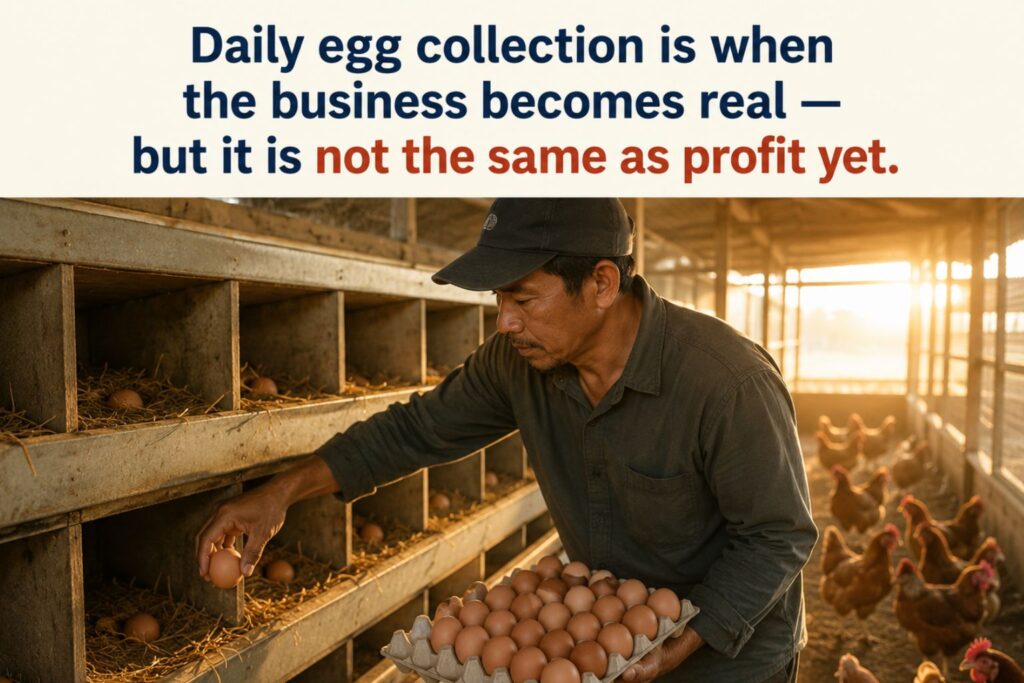
04.Confusing Cash Flow With Profit
Seeing daily egg sales and assuming the business is profitable — without accounting for ongoing daily feed costs and accumulated startup investment.
05
05.Poor Biosecurity Habits
Allowing unlimited visitors, not disinfecting entry points, and failing to isolate sick birds quickly. Disease spreads fast in a confined flock.
06.No Record Keeping
Not tracking daily feed consumption, production numbers, mortality, or expenses. Without records, you cannot identify problems early or know your true profit position.
Egg Production Timeline and What Income Really Looks Like
Most quality layer breeds will begin producing eggs between 18 and 20 weeks of age. However, the transition into full production is gradual, not immediate. Here is a realistic production curve to set your expectations correctly:
- Week 18–20:First eggs appear. Around 10–40% of birds laying depending on management quality and breed.
- Week 20–24:Production climbs steadily. Income begins covering a growing portion of daily feed cost.
- Week 24–30:Peak production for most breeds. Expect 70–90% of birds laying on good days.
- Week 30–80:Sustained production phase. Output gradually declines from peak as birds age.
At peak production, 100 birds laying at 80% efficiency produces roughly 80 eggs per day — that is about 8 to 9 trays of 9 eggs per week, depending on your tray size. Daily income from this depends entirely on your local egg selling price.
What most beginners fail to grasp is that this income, while real and regular, must first cover your daily feed cost — and that only after covering feed does any surplus count as progress toward recovering your startup investment. The phase between “first eggs” and “first real profit” is longer than most people expect, and without planning, it is the phase where farmers quietly run into trouble.
3 Honest Profit Scenarios: What Could Actually Happen
The most useful thing you can do before starting is test your numbers against different real-world conditions. Feed prices fluctuate. Production levels vary. Egg market prices are not always predictable. Here are three practical scenarios based on a 100-layer farm over an 80-week cycle:
📊 100-Layer Farm — Profit Scenarios Over 80 Weeks
| Scenario | Feed Situation | Production Result | Feed to Break-Even | 80-Week Outcome |
|---|---|---|---|---|
| Scenario 1 Best Case | Low cost — home-mixed feed from local ingredients | Strong — ~40% laying by week 20, builds steadily to peak | Under 800 kg by week 20 | +46% Profit |
| Scenario 2 Moderate | Average commercial feed prices | Moderate — farm self-sustaining by week 21 | Over 800 kg by week 21 | +13% Profit |
| Scenario 3 Difficult | High feed prices due to market conditions | Poor — only 10% laying by week 20 (vs. expected ~40%) | Over 1,200 kg by week 26 | −39% Loss |
What does Scenario 3 mean in practice? For every $100 you invest, you lose approximately $39. This is not an extreme worst-case invented to scare you — it is the reality for beginners who start without planning, experience unexpected feed price increases, or manage their flock poorly during the critical development weeks.
The good news is that Scenario 3 is largely preventable. Understanding your local feed prices before you start, having a proper feeding plan, and maintaining consistent management are the three things that most separate Scenario 1 from Scenario 3.
Test Your Own Numbers Before You Commit
Before spending anything on birds, housing, or feed, run your own scenario analysis using your local prices. The Poultry Pro Planner lets you enter your exact feed cost, expected egg selling price, and flock size — then shows you when your farm will become self-sustaining, how much feed investment you need to fund upfront, and what your projected return looks like under different conditions.
This is the single most valuable step you can take as a beginner before investing. Download it free from the link below.
The 5 Factors That Determine Your Final Profit
No single factor controls your outcome. All five of these work together — and if one falls apart, it affects all the others:
- Daily management quality:How consistently you care for your birds every day. Small daily errors compound into large losses over a 20-week period before you even see an egg.
- Feed cost and consistency:The price you pay for feed and the quality you maintain throughout the cycle. This is the largest single cost driver in your business.
- Egg selling price:The local market price for eggs. Understand this before you start — not after. A market that is oversupplied with eggs will squeeze your margins significantly.
- Flock health and survival rate:Disease outbreaks, poor biosecurity, or missed vaccinations can reduce your productive flock size dramatically. Every bird lost before production peak is a direct loss of future income.
- Management stability over time:Your ability to maintain your routines without skipping steps, especially during difficult periods. Inconsistency is the silent profit killer in layer farming.
Conclusion: What It Actually Takes to Profit From 100 Layers
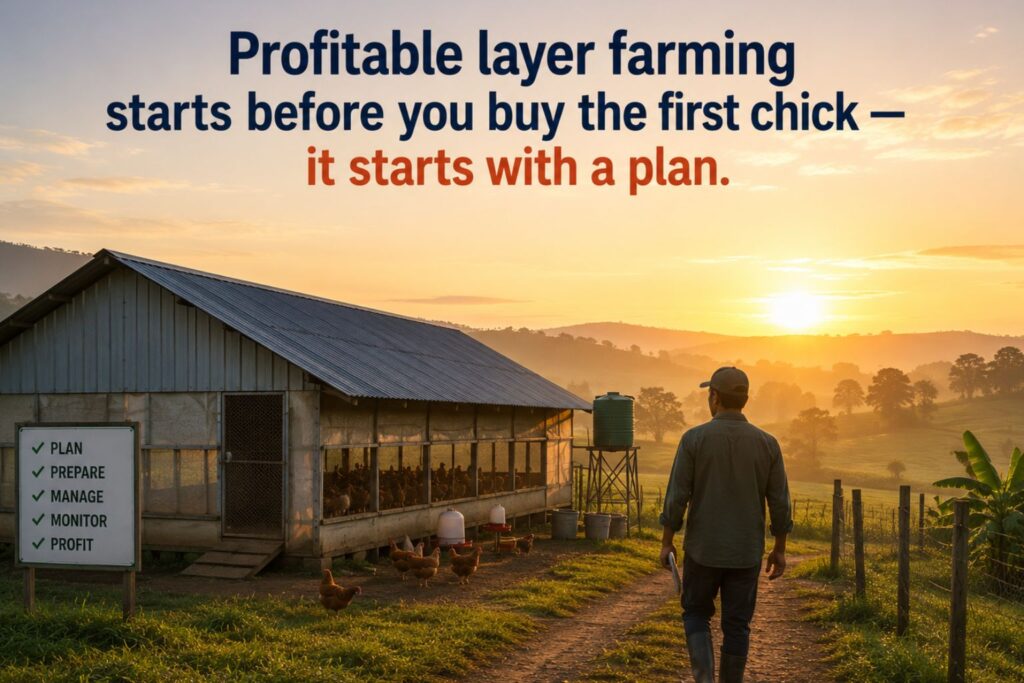
The Honest Summary
100 layers can make you a real, meaningful profit. The three-scenario breakdown in this article shows that under good conditions, a beginner can achieve a 46% return over 80 weeks. That is a genuinely solid result from a small-scale operation that requires no heavy machinery and minimal land.
But the same article shows that a 39% loss is equally possible — and it does not require catastrophic bad luck to get there. It just requires starting without a plan, underestimating feed costs, or being inconsistent in your daily management.
The single most useful thing you can do right now is this: get your local numbers together, run your scenarios, and go in knowing exactly what you are committing to. That preparation will serve you better than any shortcut, tip, or trick you could find.
Before you buy a single chick, make sure you can answer these five questions:
- What is the current price of layer feed per kg in your area?
- What is the current selling price for a tray of eggs in your local market?
- Do you have a housing plan — or the ability to build one within your budget?
- Do you have a daily feed management guide for each stage of the cycle?
- Have you run your own profit scenario using your local prices, not someone else’s?
If you can answer all five confidently, you are more prepared than the majority of people who start a layer farm. That preparation is what makes the difference between Scenario 1 and Scenario 3.