So you just brought home a fluffy box of day-old chicks. They’re adorable, they’re peeping, and they all look exactly the same. Sound familiar?
Whether you’re raising backyard chickens, running a small farm, or just got a little too excited at the feed store — figuring out which chicks are hens and which are roosters is one of the first real challenges of chicken keeping. And honestly? It’s trickier than most people expect.
Let’s walk through the most reliable methods, from the simple to the “please don’t try this at home without practice.”
Why Does It Even Matter?
Before we get into the how, let’s talk about the why. If you live in the city, most ordinances allow hens but ban roosters (because, well, 5am crowing). If you’re raising chicks for egg production, you want hens. If you’re a hatchery or breeder, sorting by sex early saves a lot of feed money.
Knowing sooner rather than later just makes life easier.
Method 1: Vent Sexing — The Professional Way
This is the gold standard of chick sexing, and it’s what commercial hatcheries use. Trained professionals can sex chicks within the first 24–48 hours of hatching with about 90–95% accuracy.
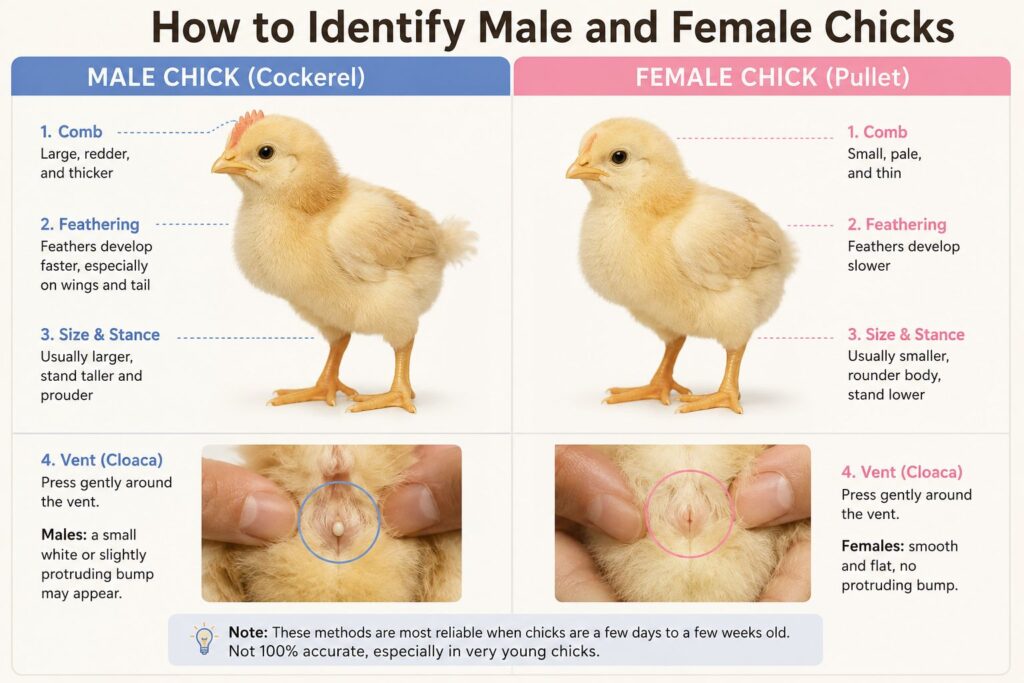
Here’s the basic idea: a trained sexer gently squeezes out the contents of the chick’s cloaca (the vent) and examines the tiny internal bump. Males have a small protrusion; females usually don’t — or have a very different shape.
The honest truth? This method takes years of training to do reliably. It can also injure or kill the chick if done incorrectly. Unless you’ve been properly trained, please leave this one to the professionals.
Method 2: Feather Sexing — Fast and Surprisingly Accurate
Some chicken breeds are specially bred to be “feather-sexable.” This works because male and female chicks of these breeds grow their wing feathers at different rates.
Here’s what to look for at just 1–3 days old:
- Female chicks tend to have two distinct rows of feathers on their wings — longer primary feathers and shorter coverts, creating an uneven, layered look.
- Male chicks usually have wing feathers that are all roughly the same length, giving a more uniform, even appearance.
This only works on breeds specifically developed for this trait (many commercial egg-laying breeds are feather-sexable). If you bought a mixed batch of barnyard chicks, this method may not apply.
Method 3: Color Sexing — The Easiest One
Some breeds are sex-linked, meaning males and females hatch out in different colors. This is probably the most foolproof method when it applies.
Common examples:
- Black Sex-Links: Males hatch yellow or white; females hatch black with a reddish tint.
- Red Sex-Links (Golden Comets, ISA Browns): Males are whitish-yellow; females are reddish or buff-colored.
- Barred Rock crosses: Males often have a larger, more defined white spot on their heads at hatch.
If you know the breed and it’s a sex-link variety, you can sort them in seconds right out of the incubator.
Method 4: Watching Them Grow — The Patient Approach
If none of the above applies, time is your best friend. By 4–8 weeks, the differences start showing up clearly.
Signs you might have a rooster:
- Comb and wattles appear earlier and grow faster. By 4–6 weeks, cockerels often have noticeably larger, redder combs than pullets of the same age.
- Hackle feathers (around the neck) start to look pointy and shiny on males, rounded on females.
- Saddle feathers (above the tail) also become long and pointed on males.
- Behavior: Cockerels tend to be bolder, more aggressive, and will often start chest-bumping other chicks early. They also practice crowing — and yes, those first attempts are as awkward as they sound.
- Body shape: Males often develop a more upright, confident posture. Females tend to be rounder and lower to the ground.
Granted, this method requires patience. But for backyard keepers with mixed breeds, it’s often the most realistic option.
A Few Honest Caveats
- No method is 100% accurate, especially in the first few weeks.
- Breed matters enormously. Some breeds are notoriously hard to sex early (Silkies, I’m looking at you).
- Even experienced farmers get surprised. That sweet hen you named “Daisy” crowing at dawn happens to the best of us.
Quick Reference Cheat Sheet
| Method | Best Age | Accuracy | Skill Required |
|---|---|---|---|
| Vent sexing | Day 1–2 | 90–95% | Very high |
| Feather sexing | Day 1–3 | 85–90% | Low (breed-dependent) |
| Color sexing | Day 1 | ~99% | None (breed-dependent) |
| Physical traits | 4–8 weeks | 95%+ | Low |
Final Thoughts
Sexing chicks is part science, part experience, and part waiting. If you’re a beginner, don’t stress too much about getting it right on day one. Watch your chicks as they grow, note the differences, and trust that by 6–8 weeks, the roosters will usually be waving their little red flags for you.
And if you end up with more roosters than you planned? Well… that’s just part of the adventure of keeping chickens.
Happy hatching! 🐣