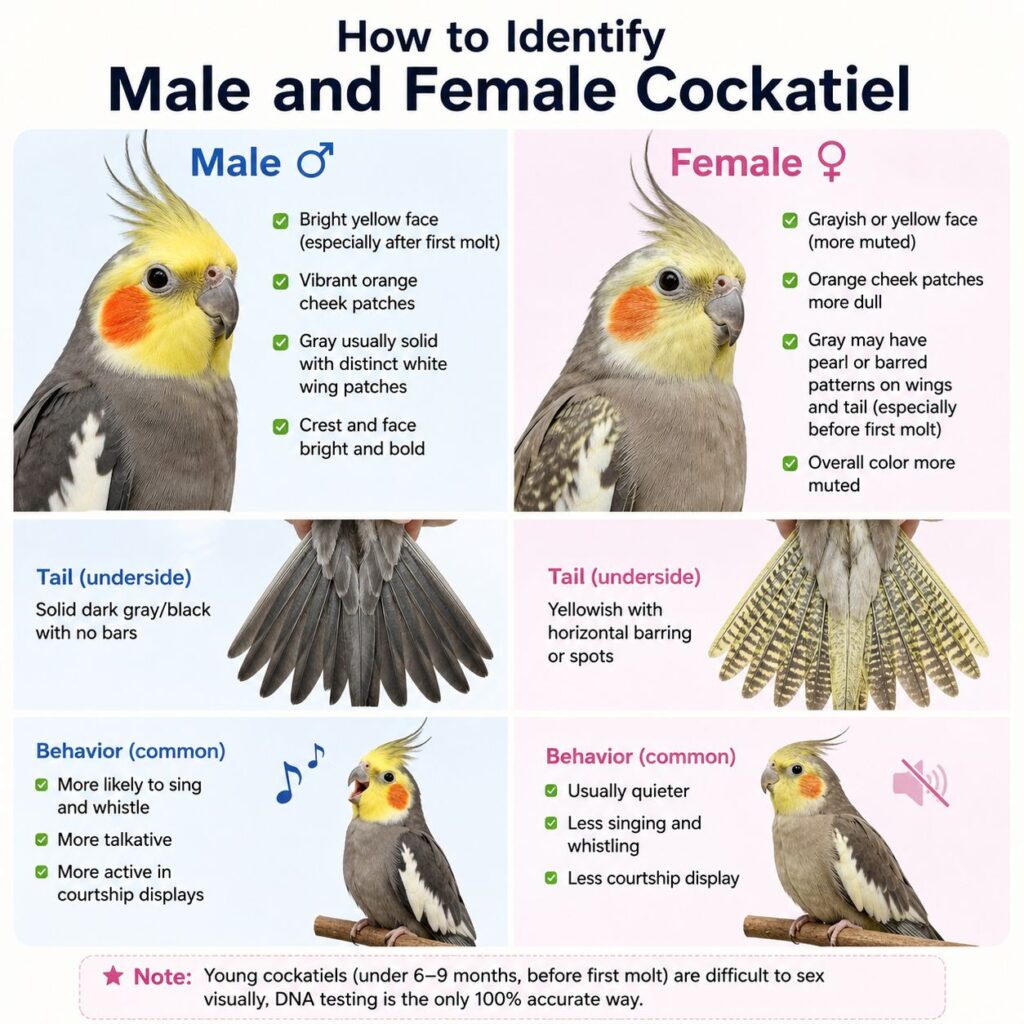
If you’ve ever stared at your cockatiel and wondered, “Wait… are you a boy or a girl?”— you’re not alone. It’s one of the most common questions new cockatiel owners ask, and honestly, it’s not always obvious at first glance. But once you know what to look for, it becomes much easier.
Let me walk you through everything I’ve learned about telling male and female cockatiels apart.
First Things First: Age Matters
Before anything else, you need to know how old your bird is. Most of the visual differences between male and female cockatiels only become clear after the first molt, which usually happens around 6 to 12 months of age.
If your cockatiel is still a baby, both sexes look almost identical. So if your bird is very young, a little patience goes a long way.
1. Look at the Face Color
This is probably the easiest and most reliable method for adult cockatiels.
Male cockatiels typically have a bright, vivid yellow face. The color is bold and well-defined — you really can’t miss it. Their cheek patches (those little orange circles on the sides of their face) are usually deep, rich orange.
Female cockatiels, on the other hand, tend to have a more muted, pale yellow or grayish face. Their cheek patches are there, but they look more washed out compared to the males.
Think of it this way: if the face looks like it’s glowing, it’s probably a male. If it looks a little more understated, likely a female.
Note: This applies mainly to the common gray (normal) cockatiel. Some color mutations like lutinos or albinos make this trickier — more on that below.
2. Check the Underside of the Tail Feathers
Flip your bird over gently (or wait until they climb on something where you can peek underneath) and look at the tail feathers from below.
Females usually have yellow or white barring — small horizontal stripes — on the underside of their tail feathers. You might also notice spots or barring on the underside of their wings.
Males typically have plain, solid-colored tail feathers underneath with no barring or spots at all.
This is actually one of the most reliable ways to tell them apart, especially in young birds after their first molt.
3. Listen to Them
This one might surprise you, but behavior is a big giveaway.
Male cockatiels are natural performers. They love to sing, whistle, and mimic sounds. If you have a cockatiel that’s constantly singing little songs, wolf-whistling, or trying to learn tunes — there’s a very good chance it’s a male. They’ll often sing to mirrors, toys, or even your hand.
Female cockatiels are generally quieter. They might make contact calls or the occasional chirp, but full-on songs and whistling are less common. This doesn’t mean females are boring — they can be just as sweet and affectionate — they’re just not as likely to put on a musical show.
4. Watch Their Behavior
Beyond singing, there are some other behavioral differences worth noticing.
Males tend to:
- Bob their heads enthusiastically
- Tap or drum on surfaces (it’s a courtship thing)
- Puff up and strut around
- Be more outgoing and showy overall
Females tend to:
- Crouch down low with their tail raised (a mating posture)
- Hiss or become protective around nesting spots
- Chew on wood or paper more obsessively (nesting instinct)
- Be a bit more reserved or independent
Of course, every bird has its own personality, so don’t rely on behavior alone — but combined with the physical signs, it paints a pretty clear picture.
5. Watch for Egg Laying
Okay, this one’s a dead giveaway — if your cockatiel lays an egg, it’s definitely a female. No male has ever managed that one.
Females can lay eggs even without a male present. These eggs won’t hatch, but it does happen. If you notice your bird sitting on the bottom of the cage or acting like she’s nesting, keep an eye out.
What About Color Mutations?
This is where things get a bit tricky. Certain cockatiel color mutations make visual sexing much harder.
Lutino cockatiels (the white or pale yellow ones with red eyes) are a good example. Both males and females look very similar — pale all over with no obvious color contrast. In this case, the tail barring method is still your best bet. Female lutinos often retain faint barring under the tail, while males are usually plain.
Pied cockatiels are another tricky one. The irregular coloring makes facial differences hard to read.
For these mutations, behavior, barring, and sometimes DNA testing are the most reliable options.
The Most Reliable Method: DNA Testing
If you’ve gone through all of this and you’re still not sure, there’s always DNA sexing. It’s a simple process — usually just a feather or a few drops of blood sent to a bird lab — and it gives you a definitive answer.
Many breeders offer DNA-sexed birds, and some vets can help arrange testing. It’s especially useful for mutations where visual methods fall short.
Quick Reference Summary
| Feature | Male | Female |
|---|---|---|
| Face color | Bright yellow | Pale yellow or gray |
| Cheek patches | Deep orange | Lighter orange |
| Tail underside | Plain, no barring | Yellow/white barring |
| Singing | Frequent, melodic | Rare |
| Behavior | Showy, active | Calmer, nesting instinct |
| Egg laying | Never | Possible |
Final Thoughts
Figuring out your cockatiel’s gender is part of the fun of getting to know your bird. Take your time, observe their habits, check the physical clues, and soon enough it’ll click.
And honestly? Whether your cockatiel is a boy or a girl, they’re going to be just as wonderful either way. These little birds have so much personality packed into such a small body — that’s what really matters.
If you’re still unsure after all this, a quick visit to an avian vet or a DNA test will clear things up for good.
Got questions about your cockatiel? Drop them in the comments below — I’d love to help!